Electronics Repair vs ReplacementWhen to fix it, when to source new — and what the real costs are
The default answer has become “just replace it.” That instinct is costing businesses — and the planet — more than most people realise. Here’s a straight framework for making the call properly, not reactively.
The knee-jerk comparison looks simple: new unit at $400 vs a repair quote at $280 — replace and get something fresh. But that ignores several very real costs that only show up later.
Repair
- Labour + parts only — not full unit cost
- Often same-day to 3 days turnaround
- Data and config preserved
- Low environmental footprint
- Known fault, known fix — fewer unknowns
Replace
- Full unit price plus delivery
- 3–10+ days lead time (longer for commercial gear)
- Potential data and configuration loss
- High e-waste and manufacturing footprint
- New device, new compatibility unknowns
Downtime cost alone often tips the calculation. What does a day without that device actually cost your operation? For commercial or specialist equipment, repair is frequently the smarter economic choice — not just the sentimental one.
Not every broken device is worth fixing. But some signals are hard to argue with.
Industrial control panels, bespoke embedded systems, vintage test equipment — finding an equivalent replacement may be impossible, and sourcing new could take weeks at multiples of the repair cost.
A blown capacitor, failed voltage regulator, damaged connector, or burnt trace on a PCB. These are component-level failures — the rest of the device is fine. Binning a whole unit over a $4 component is wasteful in every sense.
Rough rule of thumb: if a competent repair costs less than 40–50% of replacement value and the device has reasonable life left in it, repair usually wins. For anything over $500–$1,000, that threshold extends further.
A skilled technician doing component-level repair can often turn things around faster than courier deliveries — particularly for anything not stocked locally in New Zealand.
To be fair, there are genuine situations where replacing is the smarter move. A good repair technician will tell you this honestly — if someone quotes you a repair on a device that clearly isn’t worth saving, walk away.
Parts are unobtainium
If the fault requires a chip that’s been obsolete for a decade and nobody stocks it, repair becomes impractical regardless of skill level.
Multiple systems are failing simultaneously
When several subsystems are degraded at once, you’re chasing failures rather than fixing a device. Repair becomes an ongoing liability.
Repair cost approaches replacement cost
If a quote hits 80%+ of the price of a common, easily-sourced replacement, replace it. The economics simply don’t stack up.
End-of-life for safety or compliance reasons
Some equipment genuinely needs to be retired, not patched. Safety certification, compliance requirements, or manufacturer EOL can make continued use inadvisable regardless of repairability.
New Zealand generates roughly 20 kg of e-waste per person per year — much of it ending up in landfill, where toxic materials leach into soil and groundwater. Manufacturing a new electronic device is resource-heavy: rare earth metals, significant water use, carbon-intensive supply chains.
ESG & Sustainability Reporting
- Repair decisions are tangible and quantifiable
- “Repaired X devices, diverted Y kg of e-waste”
- Real numbers — not vague pledges
- Directly supports circularity commitments
Right-to-Repair Trajectory
- Legislation gaining traction internationally
- Being discussed actively in NZ policy circles
- Repair infrastructure is appreciating in value
- Aligns business practice with regulatory direction
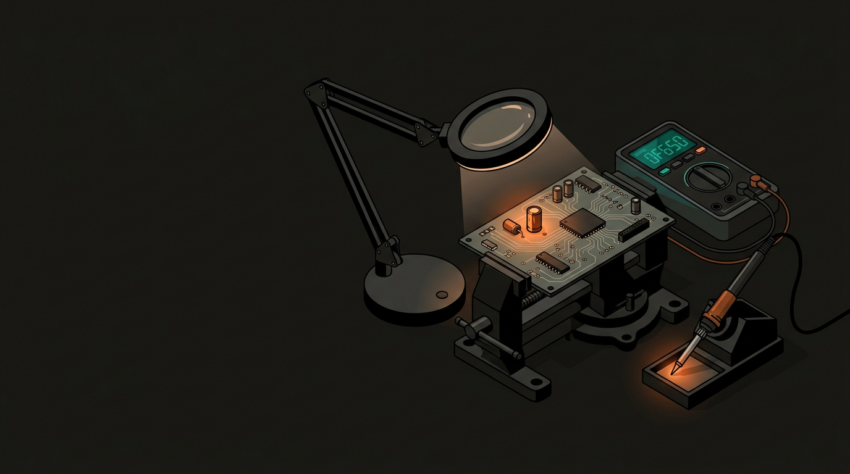
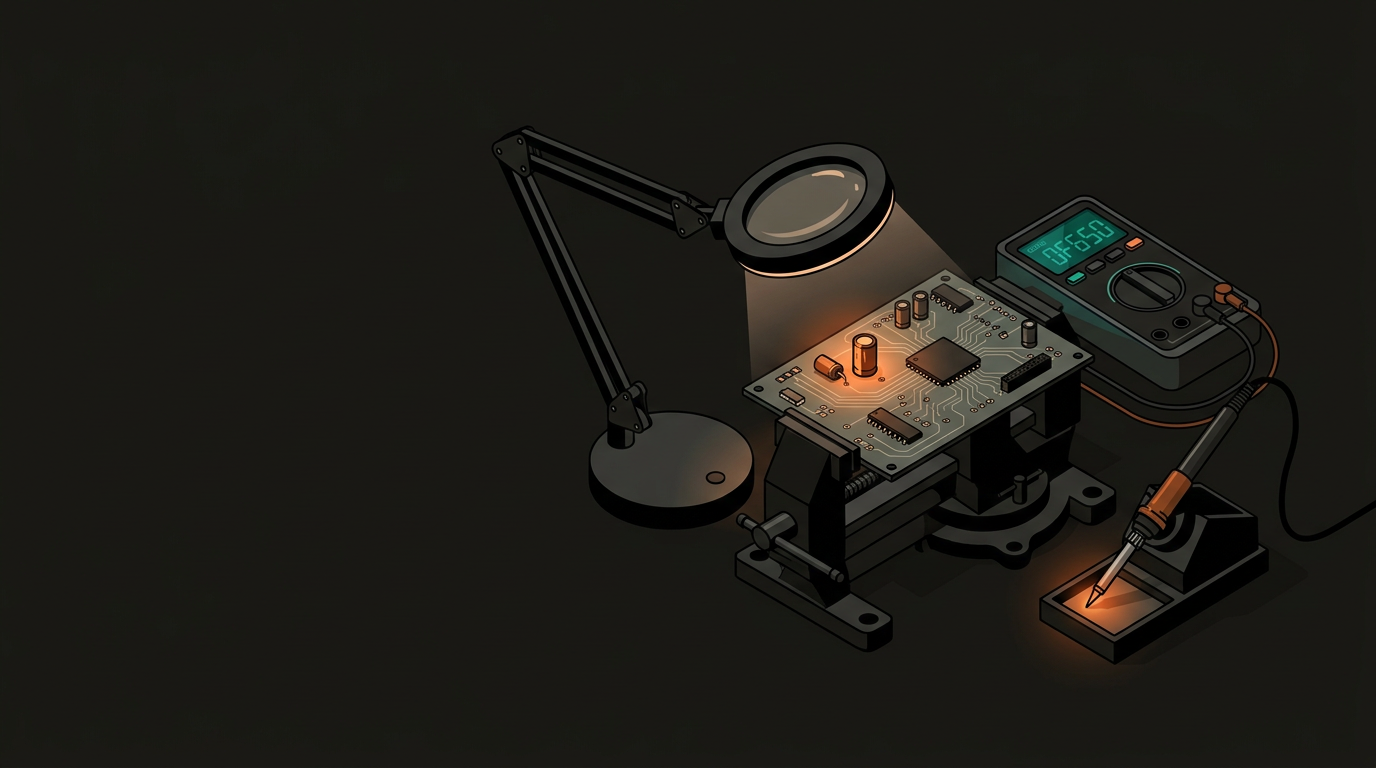
Most repair shops do surface-level work — screen replacements, battery swaps, connector fixes. Useful, but limited. Component-level diagnostics require proper equipment: oscilloscopes, thermal cameras, bench power supplies, soldering stations capable of fine-pitch SMD work — and the experience to know what measurements are actually telling you.
The kinds of repairs that make clear economic sense:
Standing in front of a broken device and not sure what to do? Work through this in order.
Get a diagnostic first
If you don’t know what’s wrong, find out. A good technician should tell you the fault and a realistic repair cost before you commit to anything.
Calculate the true replacement cost
Include lead time, configuration effort, compatibility risks, and staff retraining — not just the sticker price. The gap often narrows considerably.
Apply the percentage rule
Repair cost under 50% of true replacement cost? Almost always worth it. Over 80%? Probably replace — unless the device is specialist or irreplaceable.
Factor in specialisation and customisation
If the device is specialist, customised for your workflow, or difficult to source — lean hard toward repair regardless of the cost percentage.
Assess your downtime tolerance
If you need it working this week, repair is often the faster path — especially for anything not stocked locally in New Zealand.
If you’re in Auckland and have a device you’re not sure about, GeoSaffer offers diagnostics and straight assessments. We’ll tell you whether it’s worth repairing, what the repair involves, and give you a realistic quote. If it genuinely isn’t worth fixing, we’ll say that too. We work on commercial electronics, PCBs, industrial control systems, appliances, and embedded devices — and because we also do machine building and software development in-house, we can often solve problems that go well beyond a simple component swap.
Talk to GeoSaffer about your device →