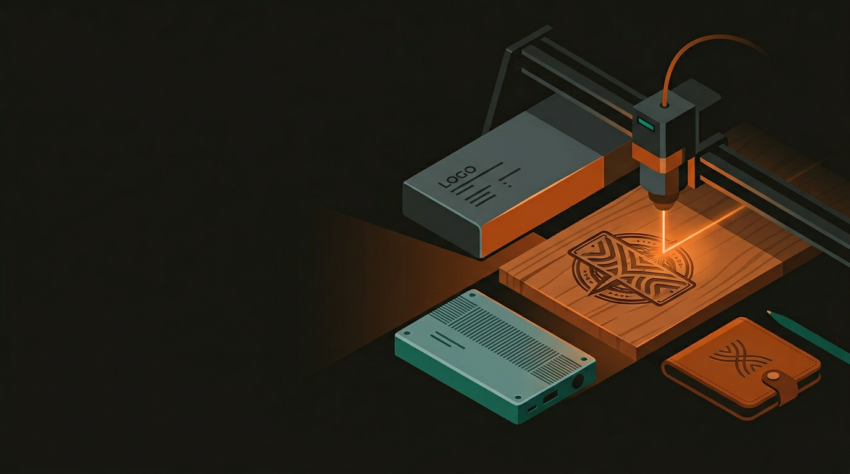
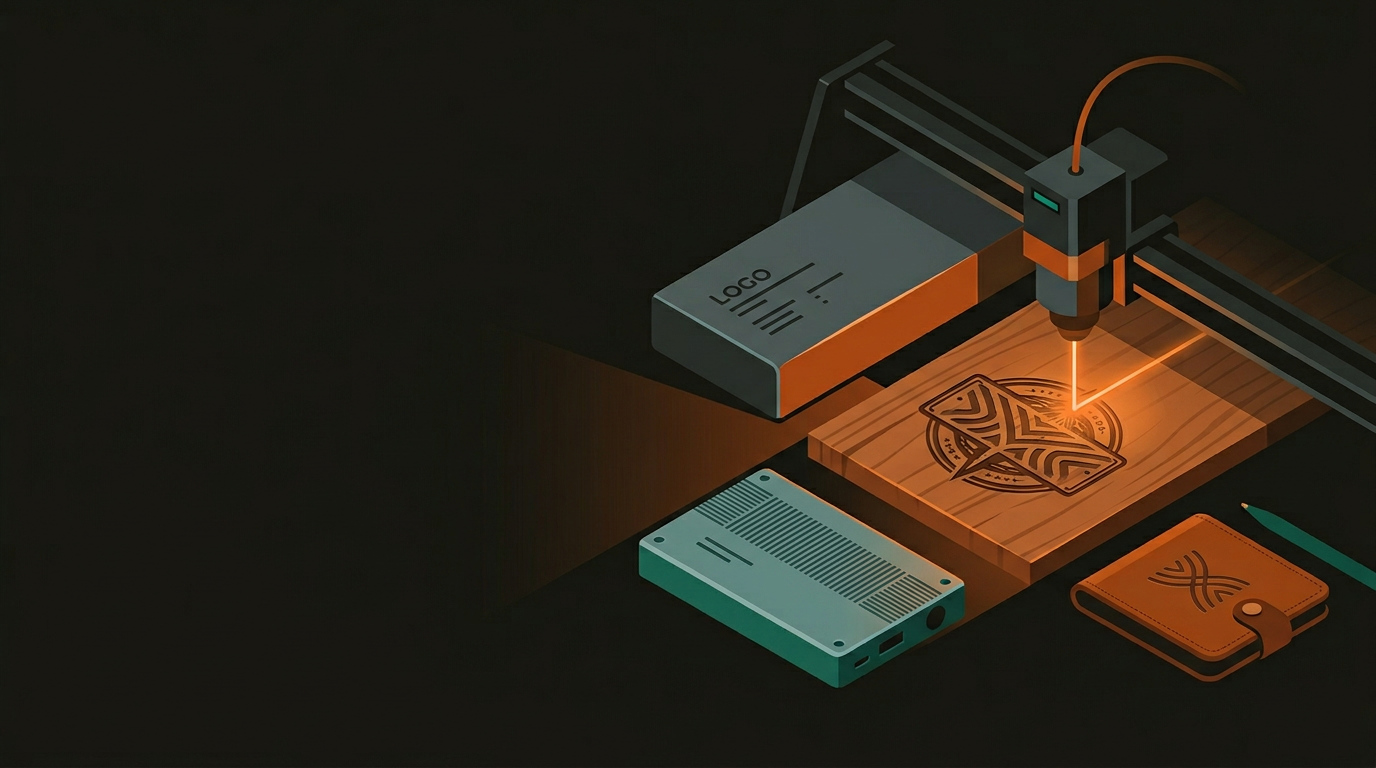
Laser Engraving for Custom Branding Professional product marking and signage for NZ businesses
Pad printing sits on top of the material. Laser engraving is part of it — a mark that cannot peel, fade, or wash off. For NZ businesses competing against imported goods, that quality signal carries real weight. Here’s what you need to know about material range, design decisions, and the business case.
Laser engraving physically removes or alters the surface using a focused beam of light. That distinction from surface-applied methods matters, because the result is a mark with properties those methods simply can’t replicate.
Cannot peel, fade, or wash off — it’s part of the material itself. Survives the conditions the product operates in.
Scales to fine detail — logos, small text, serial numbers, QR codes — at a resolution no physical tooling can match.
No inks, chemicals, or tooling changeovers. Small runs — even quantities of 10–50 — are genuinely viable.
The assumption that laser engraving is only for wooden trophies and acrylic awards is stubbornly persistent. The actual material range is much broader.
The machine matters less than most people think. The decisions you make in the artwork stage have a significant effect on what comes out the other end.
Laser engraving works best with vector files — AI, SVG, DXF. Raster images can work for photographic engraving, but for logos and text, vector gives you clean edges regardless of scale.
Your design will ultimately be a tonal mark — lighter or darker than the base material. Prepare artwork in high-contrast black and white. Complex gradients usually need to be converted to halftone patterns.
Fine serifs, hairline strokes, and text below 6–8pt can lose definition depending on the material. If your logo carries very fine detail, ask whether a simplified version will hold up better at small scales.
Engraving around a logo — leaving it raised while the background is engraved away — creates a striking embossed effect, particularly in wood and acrylic. Worth considering if you want something that reads differently from a standard mark.
Material variation, surface coatings, and even moisture content in timber can affect results. A sample on your actual material before running a full batch is not extra caution — it’s just how the process should work.
Laser engraving occupies an interesting position: industrial in capability, personal in application. These are the use cases where NZ businesses are seeing the most value.
Product Marking
- Furniture and homewares — maker’s mark on every piece
- Electronics enclosures — port labels, model numbers, regulatory symbols
- Industrial parts — serial numbers, compliance marks
- Leather goods — wallets, bags, notebooks, belts
Hospitality & Retail
- Wooden menus, branded coasters, custom signage
- Chopping boards and glassware for hospitality
- Corporate gifting — personalised at scale
- Individual names or messages without tooling changes
The economics are more favourable than most people expect going in. No tooling costs means no upfront investment — you pay for setup and run time. Short runs of 10–50 units are viable, which matters for NZ businesses that can’t always commit to large minimums. Most jobs are ready in days.
Per-unit cost drops with volume, but quality doesn’t vary. The tenth piece looks the same as the thousandth. For businesses that need consistent branding across a product line, that repeatability has genuine commercial value.
GeoSaffer’s team in Auckland works across a wide range of industries — custom homewares, hospitality branding, electronics enclosures, industrial marking. If you’ve got a product, a material, or an idea you’re not sure about, get in touch. We’ll look at your artwork, talk through your material, and run a test piece before you commit to anything.
Get a laser engraving quote →