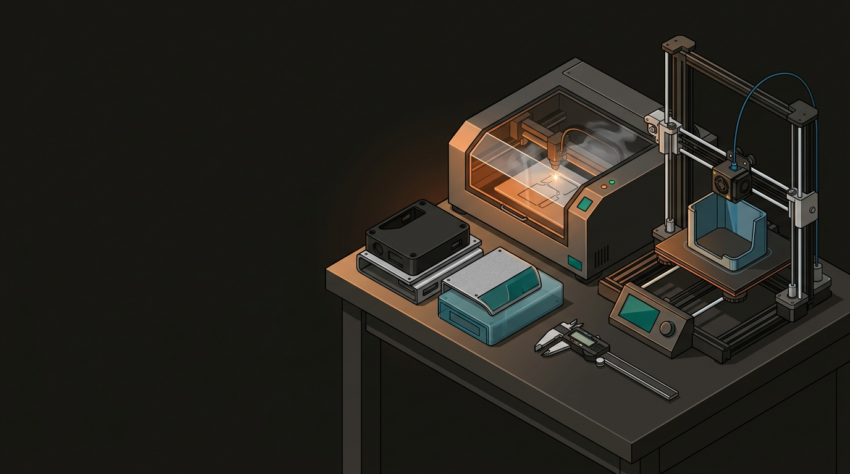
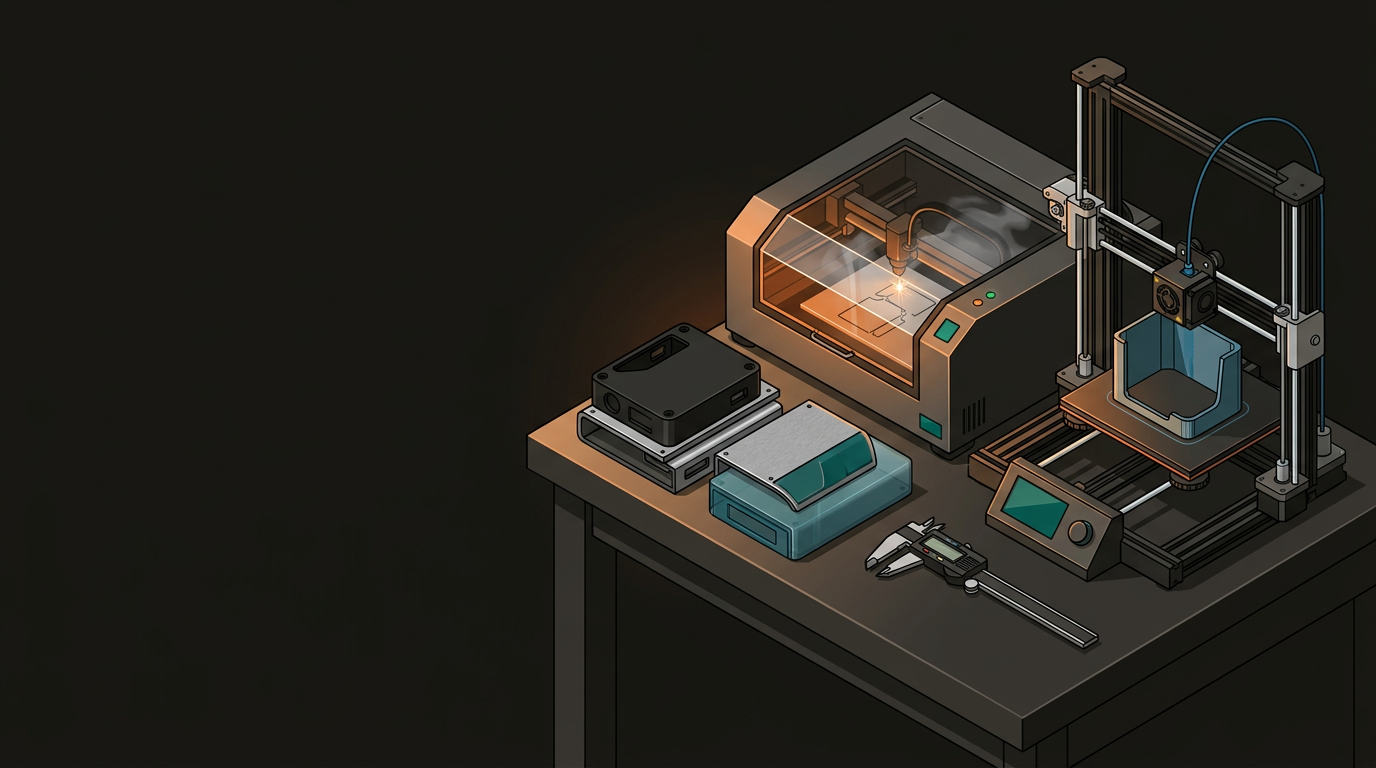
Rapid Prototyping for Hardware Startups In-house or outsourced — a practical decision framework by stage
Build out your own fabrication capability, or outsource the prototyping work? Get it wrong and you’re either burning cash on equipment that collects dust, or losing weeks chasing suppliers when you needed parts three days ago. Here’s an honest breakdown — based on where your startup actually is, not where you’re hoping to be.
A basic makerspace that can handle enclosure work, functional prototypes, and early product development doesn’t come cheap. The realistic entry point is NZ$10,000–25,000 in capital before a single part gets made — and that’s before accounting for the ongoing costs that don’t show up in the purchase price.
Production-capable unit (e.g. Bambu Lab X1-Carbon): NZ$1,800–3,500. Plus filament, maintenance, and calibration time.
For fine-detail parts: NZ$800–2,500. Requires UV curing station, wash unit, chemical handling, and ventilation.
CO₂, 60W+: NZ$3,000–8,000. Needs proper ventilation extraction. Material costs and alignment maintenance add up.
Desktop-capable: NZ$2,500–6,000. Tooling, fixturing, and the learning curve before consistent results are all extra.
Then add failed prints and wasted material during the learning curve, calibration headaches, and the opportunity cost of engineers doing maintenance instead of product work. For a pre-seed or seed-stage startup, that capital almost always has better places to go.
Outsourcing has a rough reputation in hardware circles — founders picture six-week waits and overseas vendors who don’t quite grasp what you’re building. That reputation isn’t wrong when you’re using the wrong service. With a quality local partner, the equation shifts entirely.
Iteration Speed
- 3D printed parts back in 24–72 hours
- Laser-cut panels same-day or next day
- Full prototype assembly inside a week for most jobs
- Every week saved is a week of runway you keep
Process Knowledge
- Flags wall thickness issues before the print fails
- Suggests material swaps that improve performance
- Catches geometry that will leave support marks on show surfaces
- A machine in your office doesn’t offer any of this
At low volumes — exactly where early hardware startups live — outsourcing almost always beats owning equipment on pure economics. You pay for what you use. No depreciation, no maintenance overhead, no idle machine between sprints.
The right answer changes as your startup progresses. The mistake isn’t committing to one model permanently — it’s applying the wrong model to your current reality.
Your job is validating a concept, not building infrastructure. Burn rate and iteration speed are everything. A founder spending ten hours a week troubleshooting a clogged nozzle is a problem you don’t need.
If you’re churning through small components daily, a desktop FDM printer for rough prints might earn its place. But anything structural, customer-facing, or aesthetically important should still go through a professional service — investors who handle a prototype do notice the quality difference.
You may now have the capital to justify some in-house capability. But continue leaning on external partners for complex work and specialist processes. Those relationships also give you overflow capacity when timelines compress — and they will.
Not all prototyping services are equivalent. A few things worth evaluating before you commit to a supplier relationship — especially as a startup where every iteration cycle matters.
Capability & Process
- 3D printing, laser cutting, CNC, electronics under one roof
- Fewer handoffs means faster turnarounds and fewer errors
- Do they help you make better parts, or just run your files?
- Honest turnaround times — not optimistic promises
Experience & Access
- Real product development experience vs. job shop mentality
- Seen a prototype iteration cycle before — from first print to production
- Can you drop in, talk through a design, and leave with parts?
- Local access matters more than founders expect until they need it
Almost every hardware product needs an enclosure. A typical iteration sequence shows exactly where a capable local partner compresses timelines in ways that genuinely matter to a startup on a funding clock.
CAD model → FDM print for form and fit check. Turnaround: 24–48 hours. Cost: minimal. Reveals assembly issues before anything expensive happens.
Revised model → resin print for surface quality assessment. Turnaround: 24–48 hours. Confirms visual quality before committing to final geometry.
Final prototype → laser-cut acrylic for a customer-facing demo unit. Same or next day. Looks like a real product.
Pre-production → CNC-routed aluminium panels or short-run injection mould evaluation. Design locked, ready to scale.
Run this through a single local partner and what might otherwise stretch across six weeks compresses to under two. For a hardware startup on a funding timeline, that’s not a marginal efficiency gain — it can be the difference between hitting a milestone and explaining to investors why you didn’t.
GeoSaffer in Auckland works across laser cutting, CNC routing, 3D printing (FDM and resin via Plastixel), electronics, and embedded systems — meaning you can move through multiple stages of a product development cycle without coordinating five separate suppliers. For a founder already stretched thin, that consolidation has real practical value.
Talk to the team about your prototype →