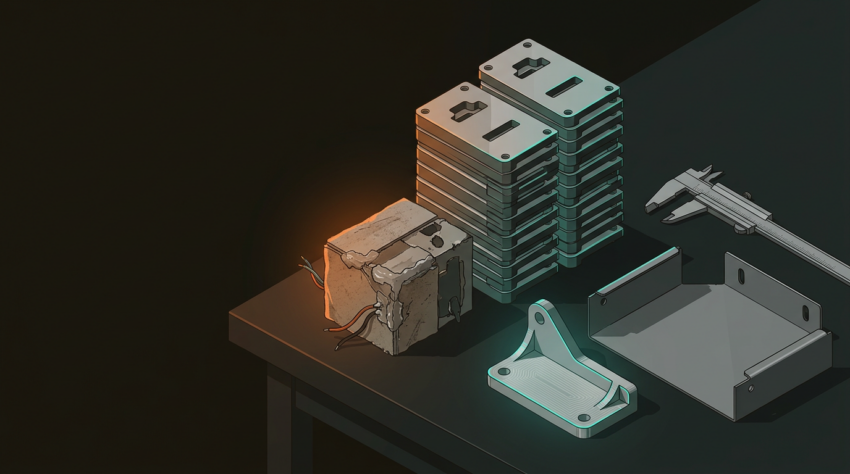
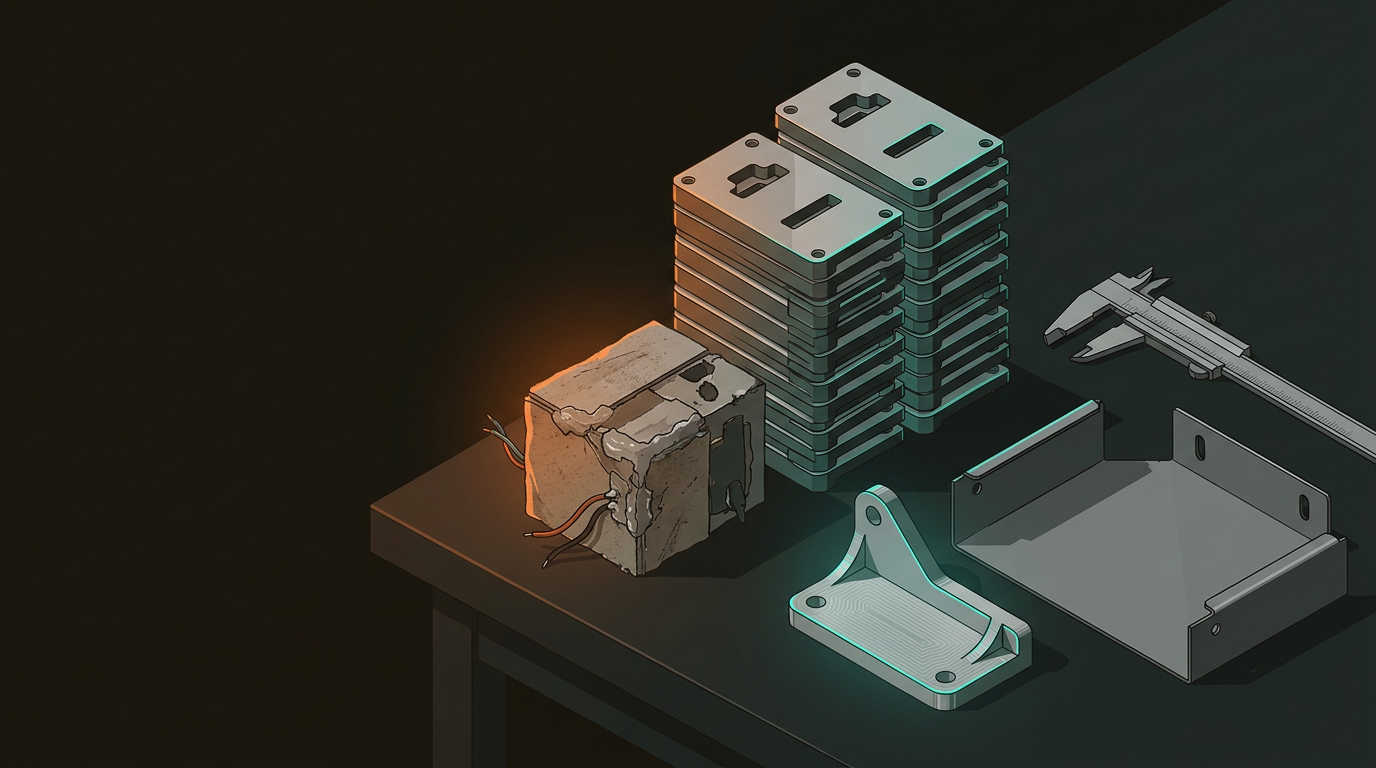
From Prototype to Production A maker’s guide to scaling your design the right way
Turning a working prototype into 50 or 500 units is a different problem from building the first one. Repeatable, consistent, and affordable are the targets — and the improvisation that got you to working fast is exactly what gets in the way. Here’s how to bridge the prototype-to-production gap without losing what makes your design worth scaling.
A prototype is a proof of concept, not a manufacturing blueprint. Every shortcut that got you to working fast — the off-spec fastener, the hand-filed slot, the glued joint that “holds fine” — surfaces as a real problem at volume. Before scaling, go through every component and ask four questions.
Sourcing & Assembly
- Can this be sourced reliably in NZ or with short lead times?
- Does assembly require a skilled hand, or can anyone follow a process?
- What’s the lead time risk if this component is unavailable?
- How many separate parts can be consolidated into one?
Tolerances & Variation
- Is this tolerance actually critical, or did I default to tight out of habit?
- What happens if this part varies slightly between batches?
- Which dimensions are truly functional vs. cosmetic?
- Where do I have tolerance stack-up risk in assemblies?
Most makers find 20–30% of their design has room to be simplified, standardised, or substituted. That audit work pays dividends immediately — in manufacturing cost, in assembly time, and in supply chain resilience.
DFM (Design for Manufacturability) is the practice of designing your product so it’s efficient and cost-effective to actually make. It’s not about dumbing anything down — it’s about being deliberate about how it gets built.
Every separate component is something to source, store, assemble, and potentially lose. A bracket and a housing are often a single CNC-routed or 3D printed piece waiting to happen.
A design calling for 47 mm-wide aluminium strip means custom cutting or material waste. Design around standard 50 mm extrusion and your supply chain gets simpler overnight.
Tight tolerances cost money — longer machining times, more quality control, higher reject rates. Reserve ±0.1 mm for features that genuinely need it. Everything else can breathe.
Can your product be assembled in a logical, repeatable order? Small geometry changes can turn a 20-minute assembly into a 5-minute one. That difference compounds across every unit you make.
A part designed for CNC routing looks different from one designed for 3D printing or laser cutting. Talk to your manufacturer before geometry is locked — not after. That conversation is one of the highest-value investments you can make.
One of the most common scaling mistakes is staying loyal to the manufacturing method used for the prototype, even when it stops making sense at volume. The economics change dramatically as quantity increases.
Low Volume (1–100 units)
- 3D printing (FDM or resin) for prototypes and early runs
- Laser cutting for flat sheet panels, brackets, and enclosures
- CNC routing for aluminium, wood, and engineering plastics
- Hand fabrication where repeatability isn’t yet the priority
Higher Volume (100–1000+ units)
- CNC routing for tight-tolerance structural components
- Sheet metal with bending for durable enclosures
- Production 3D printing where geometry justifies it
- Injection moulding once unit economics stack up
Most real products use a combination of processes. The well-designed ones play to each process’s strengths rather than forcing everything through one method. CNC routing is routinely underestimated — for aluminium, wood, or engineering plastics like Delrin and HDPE, it offers excellent repeatability at turnaround speeds that often surprise people.
Prototype materials are chosen based on availability, cost, and ease of working. Production material choices need to carry more weight — across batch consistency, local availability in NZ, end-use performance, and volume pricing.
Does this material vary in ways that affect your product? Generic filament from TradeMe and qualified engineering-grade material from a consistent supplier are not the same thing.
Freight costs mean exotic materials sourced offshore become surprisingly expensive once shipping and wait times are factored in. Design around materials with strong local distribution.
UV exposure, temperature cycling, load, moisture, chemical contact. What does your product actually face once it leaves your workshop? Prototype conditions rarely match real-world ones.
Material costs look very different when you’re buying a sheet versus a pallet. Factor volume pricing into your cost model before setting a production price — not after.
Scaling is supposed to make things cheaper per unit — but that only happens if you actively engineer cost out. Most of the real leverage points are in setup costs, material utilisation, and eliminating hand-finishing steps.
Setup vs. Run Costs
- Most processes carry setup costs spread across the run
- A 10-unit CNC job at $40/unit may land at $12 at 100 units
- Batch orders intelligently to hit breakpoints
- Understand where the cost curve bends for each process
Finishing & Fasteners
- Eliminate hand-sanding, filing, and deburring steps by design
- That time compounds fast across every unit you produce
- Standardise fasteners — two or three sizes across the whole design
- Good nesting of laser/CNC parts can cut material waste significantly
Sometimes a handful of small design changes saves 30–40% on per-unit cost with no change to what the product actually does. That work happens in collaboration with your manufacturer — which is why talking to them before geometry is locked has such disproportionate value.
GeoSaffer in Auckland works with makers and product developers through the full prototype-to-production journey. Whether it’s a DFM review, a manufacturing process conversation, or simply getting parts made quickly and properly — bring what you’ve got and we’ll give you honest, specific advice on the best path forward. One prototype or a run of hundreds.
Talk to GeoSaffer about scaling your design →