Metal 3D Printing: Breaking Into Production What it is, where it works, and why FDM alone isn’t enough
When a part needs to be titanium, certified, and production-ready, FDM and resin printing stop being useful conversations. Metal additive manufacturing has quietly moved from niche research technology to a real production pathway — and understanding where it fits, and where it doesn’t, is increasingly relevant for engineers and manufacturers in NZ.
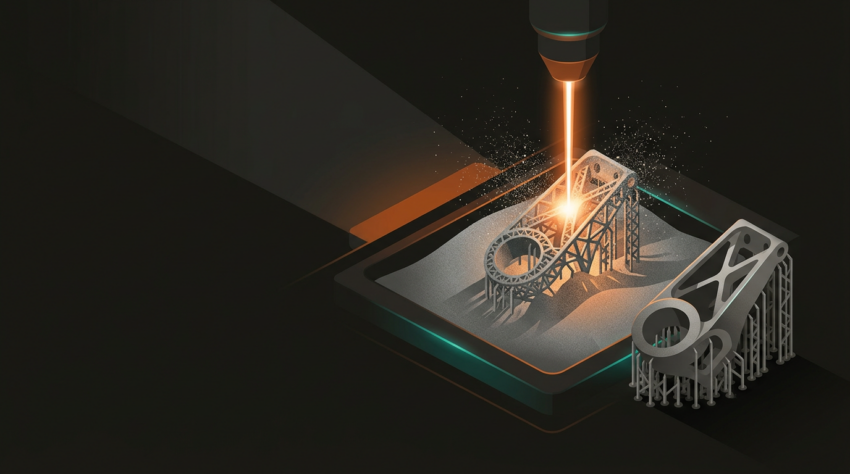
When most people say “3D printing,” they picture plastic filament or resin curing under UV light. Metal additive manufacturing works on fundamentally different principles — and none of these processes are simply “FDM but with metal.” The metallurgy, post-processing requirements, design rules, and quality assurance are categorically different.
Metal additive manufacturing has had its biggest impact in aerospace and defence — but the applications extend across medical, industrial tooling, and precision engineering in ways that are becoming practically relevant to NZ manufacturers.
GE Aviation consolidated a 20-part fuel nozzle into a single DMLS component — 25% lighter, 5× more durable. That part now flies in the LEAP engine. Not a prototype. Production hardware.
Titanium implants with patient-specific geometry and osseointegration-friendly lattice structures via DMLS. Dental crowns and surgical guides are increasingly standard in clinical settings.
Conformal cooling channels in injection moulds — channels following the mould cavity contour — can cut cycle times 20–40%. You can’t machine them. Metal AM is the only way to make them.
Heat exchangers, fluid manifolds, and hydraulic components with internal geometry a cutting tool can’t reach. Increasingly viable production candidates as costs come down.
For New Zealand’s growing precision engineering ecosystem — companies in Rocket Lab’s supply chain and the wider aerospace manufacturing sector — understanding what metal additive manufacturing can actually do is becoming genuinely relevant, not just academically interesting.
Metal 3D printing is not a universal replacement for CNC machining or casting — not yet, and probably not ever for every application. The economics, the post-processing requirements, and the design constraints are all real.
A DMLS machine represents $500,000 to several million dollars in capital. Metal powders — particularly titanium or Inconel — are expensive materials. A part that costs $10 in high-volume casting might cost $200–$500 via metal additive at low volumes. The economics only work when geometry complexity, short production runs, or performance gains justify the spend.
DMLS parts almost always need heat treatment (stress relief, HIP — Hot Isostatic Pressing), support removal, and CNC finishing of critical surfaces. Build this into your lead time and budget from day one, not as an afterthought.
Overhangs, wall thickness minimums, support strategy, residual stress — all behave differently in powder-bed fusion than in polymer printing. Knowing how to run an FDM printer doesn’t qualify you to design for metal AM. You need someone who understands it specifically.
AS9100, NADCAP, process validation — even if you can print the part, getting it certified for flight is a substantial undertaking. Don’t underestimate the gap between a functional printed part and a certified production component.
The useful question isn’t “metal printing vs. machining.” It’s understanding where each process fits in a workflow. Metal additive earns its place in specific situations — and pairs well with CNC machining for critical surfaces.
Use Metal AM When
- Geometry is too complex to machine efficiently
- Production runs are short — tooling amortisation doesn’t stack up
- Internal channels, lattices, or organic forms are required
- Part consolidation reduces assembly cost and failure points
- Weight really matters and topology optimisation unlocks gains
Stick With CNC When
- Production volumes are high enough to justify tooling investment
- Dimensional accuracy on critical surfaces is paramount
- Material certification requirements are strict
- Part geometry is achievable with cutting tools
- Unit cost at volume is the primary decision driver
Pair metal printing with CNC machining for critical surfaces and you get the best of both: geometric freedom from additive, dimensional accuracy from subtractive. That combination is where a lot of the most interesting production engineering happens.
Access to metal additive manufacturing in New Zealand is limited compared to the US, Europe, or Australia — but it’s not absent. For many NZ manufacturers, the more practical near-term pathway is metal FDM (Markforged Metal X, Desktop Metal Studio) and binder jetting — both offer lower entry costs and simpler operation than full powder-bed fusion.
Start with a DFM review — ideally with someone who knows metal AM design rules specifically, not just polymer printing. Wrong support strategy or wall thickness causes failures.
Get quotes from multiple service bureaus. Pricing varies significantly and isn’t always intuitive — the same part can vary 3× between bureaus depending on machine availability and material stock.
Ask for material certifications and process documentation if the part is structural or safety-critical. A certificate of conformance is table stakes for aerospace and medical applications.
Benchmark against CNC machining for your specific geometry and quantity. Sometimes the right answer is still a machined part — and there’s no shame in that conclusion.
GeoSaffer works across the full additive manufacturing spectrum — from rapid FDM and resin prototyping through Plastixel to advising clients on when and how to bring metal additive manufacturing into their workflow. If your project is pushing past what polymer printing or conventional machining can deliver, we’ll look at your design, talk through your options straight, and point you in the right direction.
Discuss your metal fabrication project →