Industrial 3D Printing How print farms are scaling production in 2026
The gap between prototype quantities and actual manufacturing is finally closing. The 3D print farm model — dozens of machines running in coordinated parallel, managed by real quality systems — is delivering unit economics that compete with injection moulding for runs under 10,000 parts. The businesses paying attention are getting ahead of the ones that aren’t.
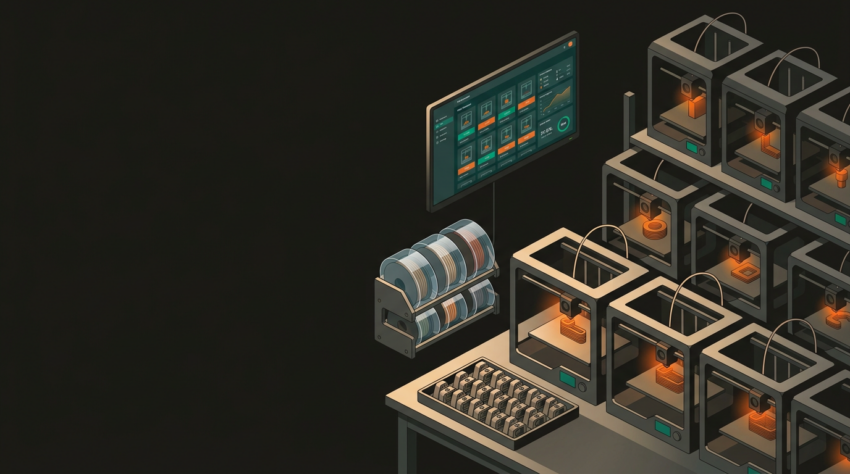
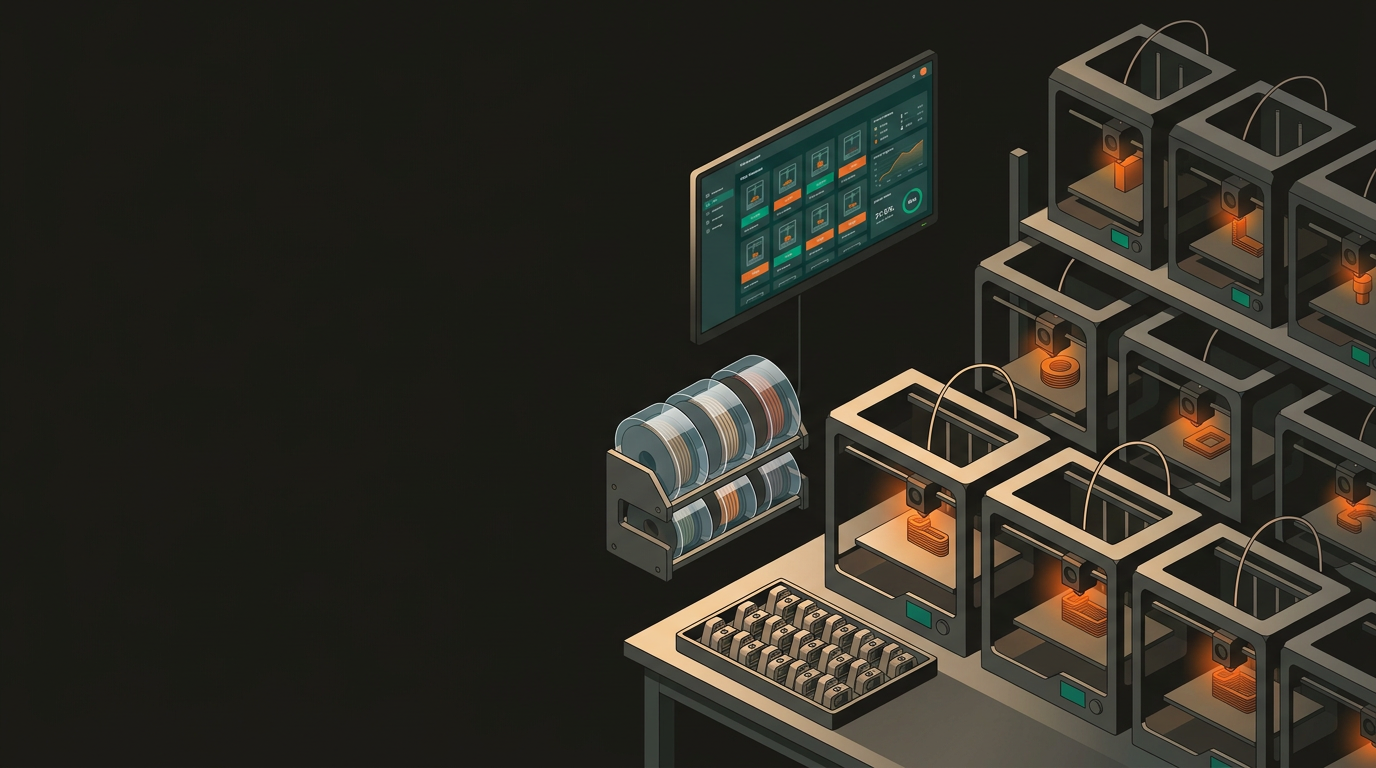
A print farm is not just a room full of 3D printers. It is a coordinated production infrastructure where dozens — sometimes hundreds — of machines run in parallel, managed by centralised software, standardised workflows, and actual quality control processes.
The economics look different at this scale. A single FDM printer running PLA might cost $0.08–$0.15 per gram in material. Bulk procurement at farm scale brings that down to $0.04–$0.07 per gram. Across 50+ machines running near-continuously, unit economics start to genuinely compete with injection moulding for runs under 10,000 parts — particularly for complex geometries that would otherwise demand expensive tooling.
Prototype Shop Scaled Up
- Multiple printer models with different profiles
- No standardised maintenance procedures
- Manual job queuing and monitoring
- No formal QC process — eyeball inspection
Purpose-Built Production Farm
- Standardised hardware — one or two printer models
- Fleet management software with live monitoring
- Incoming material QC and first article inspection
- Statistical process control at volume
Production farms typically standardise on one or two printer models — Bambu Lab X1 Carbon, Prusa XL, or industrial FDM range. That standardisation matters more than it seems. Maintenance procedures, spare parts, slicing profiles, and failure modes all stay consistent and predictable.
Environmental Controls
- Humidity-controlled filament storage — mandatory for Nylon, TPU
- Temperature-stable build enclosures for PETG, ABS, ASA
- Air filtration for operator health and part cleanliness
- Consistent ambient temperature prevents warping at scale
Fleet Management Software
- Live print progress across every machine from one dashboard
- Automatic job queuing when a machine finishes
- AI-assisted camera monitoring flags failures in 2026
- Material consumption tracked per job and per machine
Consumer printers in uncontrolled environments produce inconsistent results — that is not an opinion, it is physics. Without environmental controls and fleet management software, a 50-printer farm is just 50 individual problems waiting to happen at the same time.
Volume is only part of the equation. Choosing the right material from the start determines whether those parts actually work in service. A seemingly minor design decision — wall thickness, infill geometry, material grade — can be the difference between a part that lasts three years and one that fails in three months.
Cost leader for non-structural parts — signage, packaging inserts, consumer items. Fast and cheap. Will not handle heat or UV exposure.
Workhorse for functional parts. Better impact resistance, reasonable temperature tolerance. The sweet spot for most industrial applications.
Outdoor and high-heat environments. Warping makes them more demanding — environmental controls are essential, not optional.
Load-bearing and wear-resistant applications. Heavily used in automotive and industrial tooling jigs. Hygroscopic — storage is critical.
Flexible parts, gaskets, vibration-absorbing components. Pushes the limits of standard printer configurations at speed.
Printing a part is one thing. Consistently printing it to specification across 50 machines and thousands of parts is an entirely different discipline — and it is where a lot of operations that call themselves production farms actually fall short.
Every new filament spool gets tested: moisture content check, short test print using standardised geometry, dimensional verification. Filament from different production batches can vary in diameter consistency or colour, and both affect output quality.
Before any production run begins, the first part off each machine gets measured and inspected against the engineering specification — dimensions, surface quality, layer adhesion, all documented. Standard in aerospace for decades; now expected in production printing.
At volume, you sample — you do not inspect every part. A well-run farm uses sampling protocols based on AQL standards to catch process drift before it contaminates an entire batch.
Production parts often need deburring, support removal, painting, or secondary machining. Each step introduces variation. Standardising post-processing procedures matters as much as standardising print parameters — possibly more, because it is easier to overlook.
Most NZ manufacturers are still sending production quantities offshore — to injection moulding houses in China or larger print farms in Europe and the US. Lead times run 6–12 weeks including shipping. Minimum order quantities are high. Changing a design mid-run is expensive.
A local production-capable print farm changes that calculation entirely. Shorter lead times, easier iteration, no minimum order quantities, and supply chain resilience that recent years have demonstrated is worth paying attention to.
Questions That Reveal the Difference
- What quality control processes do you have at scale?
- How do you handle material traceability?
- What happens when a machine fails mid-run?
- Can you supply engineering documentation with parts?
Signs of a Real Production Partner
- Specific answers to QC questions — not vague reassurance
- Documented incoming material and FAI processes
- Fleet redundancy so one failure doesn’t stop the run
- Clear communication on lead times and change management
Vague answers to those quality questions mean you are talking to a prototype shop with a lot of printers. That is not the same thing as a production partner — and the distinction matters when your launch depends on it.
Plastixel — GeoSaffer’s dedicated 3D printing brand in Auckland — is building the infrastructure, quality systems, and material expertise to serve NZ businesses that need production quantities without offshore wait times or minimums. If your project has outgrown the one-printer approach, get in touch.
Talk to us about production 3D printing →